

AI in Business Strategy: How Artificial Intelligence Is Transforming the Future of Business
Introduction: Why AI Is Becoming Essential to Business Strategy
Artificial intelligence (AI) is no longer simply an emerging technology reserved for large technology companies. It has become an important part of modern business strategy, helping organizations improve decision-making, automate operations, understand customers, reduce costs, and discover new opportunities for growth.
From small startups to multinational corporations, businesses are increasingly integrating AI into their everyday operations. Companies are using AI-powered analytics to understand market trends, machine learning to predict customer behavior, generative AI to develop marketing content, and intelligent automation to improve productivity.
In 2026, the competitive advantage is no longer just about having access to technology. It is about knowing how to use it strategically.
Businesses that successfully integrate AI into their long-term plans can respond faster to market changes, deliver better customer experiences, and make more informed decisions. However, companies that adopt AI without a clear strategy may face unnecessary costs, security risks, and operational challenges.
This guide explores how AI is transforming business strategy, the technologies driving this transformation, practical applications across industries, and how organizations can develop an effective AI strategy for sustainable growth.
1. What Is AI in Business Strategy?
AI in business strategy refers to the planned use of artificial intelligence technologies to achieve business objectives, improve organizational performance, and create competitive advantages.
Rather than treating AI as an independent technical tool, businesses incorporate it into their core decision-making processes and operational plans.
AI can help organizations:
- Analyze large volumes of business data.
- Identify customer preferences and purchasing patterns.
- Forecast revenue, demand, and market opportunities.
- Automate repetitive administrative tasks.
- Improve marketing and sales performance.
- Support product development and innovation.
- Identify operational inefficiencies.
- Strengthen customer support and communication.
For example, an eCommerce business can use AI to analyze customer purchasing behavior, recommend relevant products, optimize inventory, and personalize marketing campaigns.
Similarly, a financial services company can use machine learning to identify suspicious transactions, evaluate risk, and improve financial forecasting.
The main objective is to make AI a strategic business resource rather than simply another software subscription.
2. Why AI Is Becoming a Competitive Business Advantage
Modern markets are becoming increasingly competitive. Businesses must respond to changing customer expectations, economic conditions, technological developments, and new competitors.
Traditional business strategies often depend on historical reports, manual research, and time-consuming decision-making processes. AI provides an opportunity to make these processes faster and more data-driven.
Faster and Smarter Decision-Making
AI-powered systems can process large datasets and identify patterns that would be difficult to recognize manually.
Business leaders can use these insights to understand market performance, evaluate opportunities, and make better-informed decisions.
Improved Operational Efficiency
AI automation can reduce the time employees spend on repetitive tasks such as data entry, report preparation, appointment scheduling, and customer inquiries.
This allows employees to concentrate on higher-value activities that require creativity, communication, and strategic thinking.
Better Customer Experiences
AI enables businesses to deliver personalized experiences through product recommendations, intelligent chatbots, customer segmentation, and automated communication.
Stronger Market Competitiveness
Businesses using AI effectively can identify opportunities earlier, respond to customer needs faster, and improve their products and services.
The advantage does not necessarily come from having the most advanced AI technology. It comes from applying the right technology to the right business challenges.
3. Key Areas Where AI Is Transforming Business Strategy
AI is influencing almost every major business function. Its impact goes beyond automation, helping organizations rethink how they operate, compete, and generate revenue.

3.1 AI-Powered Business Intelligence and Data Analytics
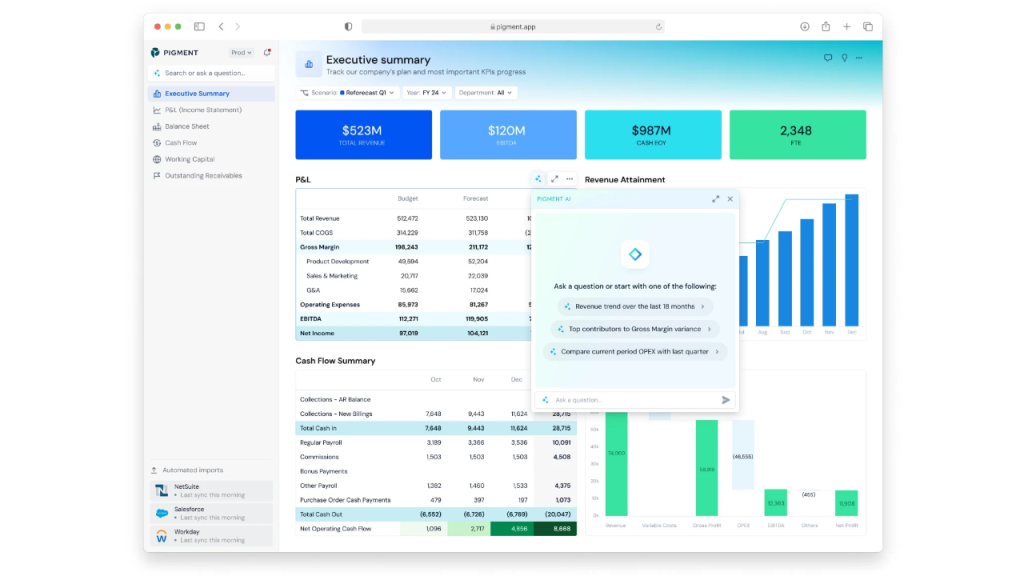
Data is one of the most valuable resources for modern businesses. However, collecting information is not enough. Organizations need to understand what that information means and how it can support better decisions.
AI-powered business intelligence tools can analyze sales records, customer interactions, website traffic, financial performance, and market trends.
Businesses can use these insights to:
- Identify their most profitable products and services.
- Forecast future sales and revenue.
- Understand customer purchasing patterns.
- Discover potential business risks.
- Evaluate marketing campaign performance.
- Make decisions using real-time or frequently updated data.
For example, a retail company can use predictive analytics to estimate which products are likely to sell during seasonal periods. This allows management to plan inventory and reduce unnecessary stock.
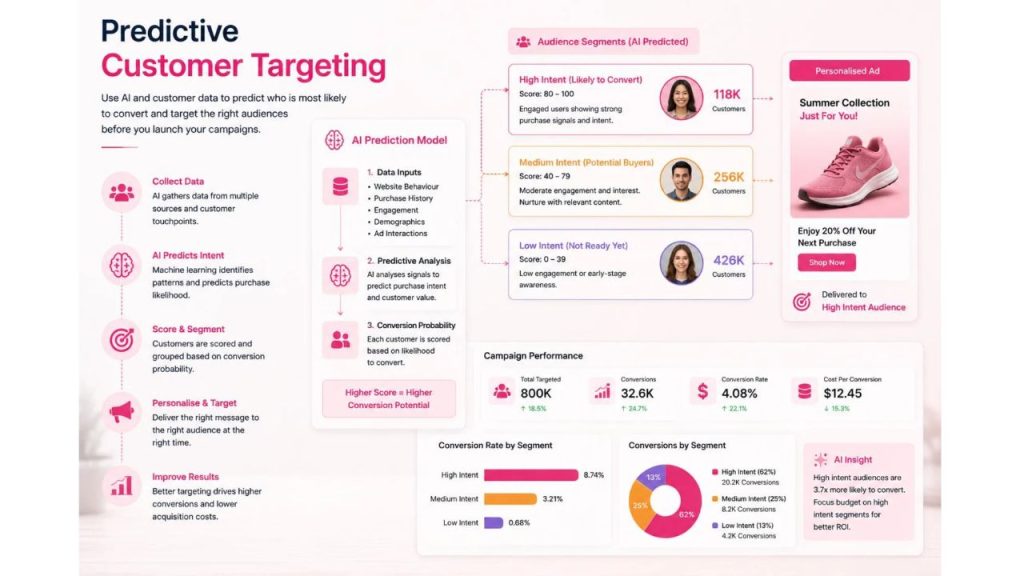
3.2 AI in Marketing and Customer Acquisition
Marketing is among the most practical areas for AI implementation.
Businesses can use AI to understand audiences, generate content ideas, improve advertising campaigns, and deliver personalized customer experiences.
Some common applications include:
- AI-generated marketing content and advertising creatives.
- Automated email marketing campaigns.
- Customer segmentation and audience targeting.
- Predictive customer behavior analysis.
- Search engine optimization research.
- Social media performance analysis.
- Personalized product recommendations.
For example, a digital marketing agency can use AI to analyze campaign performance, identify high-performing audience segments, and recommend improvements to advertising strategies.
AI can also help businesses test different marketing messages and identify which approaches attract more potential customers.
However, human creativity and brand understanding remain important. AI-generated content should be reviewed to ensure accuracy, originality, and consistency with the company’s identity.
3.3 AI in Financial Planning and Risk Management
Financial planning requires accurate information and careful decision-making. AI can help businesses improve financial visibility by analyzing historical performance, spending patterns, cash flow, and potential risks.
Businesses can use AI for:
- Revenue and expense forecasting.
- Fraud detection and suspicious transaction monitoring.
- Budget optimization.
- Financial reporting.
- Credit risk assessment.
- Cash flow predictions.
- Identifying unusual financial activity.
For example, a financial services company can use machine learning models to identify unusual transaction patterns and flag potentially fraudulent activities for further investigation.
AI can support financial professionals, but sensitive financial decisions should remain subject to appropriate human review and regulatory requirements.
3.4 AI in Human Resource Management
Human resource management is another area where AI can improve business operations.
Recruitment teams often spend significant time reviewing applications, arranging interviews, managing employee information, and evaluating workforce requirements.
AI-powered HR systems can support these activities by:
- Organizing candidate applications.
- Matching skills with job requirements.
- Automating interview scheduling.
- Supporting employee onboarding.
- Identifying training requirements.
- Analyzing workforce trends.
- Improving employee communication.
For example, a growing company can use AI-powered HR software to organize applications and identify candidates whose experience matches a particular job description.
However, AI should not independently make important employment decisions without appropriate oversight. Recruitment systems must be monitored for bias, accuracy, and fairness.
3.5 AI in Customer Service and Business Communication
Customer expectations are changing. People increasingly expect businesses to provide quick responses and convenient support across multiple communication channels.
AI-powered chatbots and virtual assistants can help companies manage routine customer inquiries around the clock.
They can assist with:
- Frequently asked questions.
- Order status updates.
- Appointment bookings.
- Product information.
- Basic troubleshooting.
- Customer support ticket classification.
- Routing complex inquiries to employees.
For example, an online hosting company can use an AI chatbot to answer questions about hosting packages, domain registration, billing procedures, and technical support.
Human support teams can then focus on complicated problems that require technical knowledge or personal attention.
3.6 AI in Supply Chain and Operations Management
Supply chain efficiency directly influences profitability and customer satisfaction.
AI can analyze supplier performance, delivery schedules, inventory levels, demand forecasts, and transportation information.
Its applications include:
- Predictive inventory management.
- Demand forecasting.
- Warehouse automation.
- Delivery route optimization.
- Supplier risk assessment.
- Equipment maintenance predictions.
- Production planning.
For example, a manufacturing company can use predictive analytics to estimate future demand and adjust production schedules accordingly.
This helps reduce overproduction, prevent shortages, and improve resource allocation.
4. The Role of Generative AI and AI Agents in Modern Business
Two important developments influencing business strategy are generative AI and agentic AI.
Although these technologies are related, they serve different purposes.

Generative AI: Supporting Creativity and Productivity
Generative AI refers to systems that can create new content, including text, images, audio, video, and computer code.
Businesses can use generative AI to:
- Develop marketing strategies and content.
- Prepare business reports and presentations.
- Generate product descriptions.
- Create design concepts.
- Summarize documents.
- Assist software development.
- Support internal knowledge management.
Popular platforms include:
- ChatGPT – Content creation, research assistance, data analysis, and business productivity.
- Google Gemini – Research, content generation, and productivity.
- Claude – Document analysis, writing, and reasoning.
- Microsoft Copilot – AI assistance across Microsoft productivity tools.
Agentic AI: Moving Beyond Simple Automation
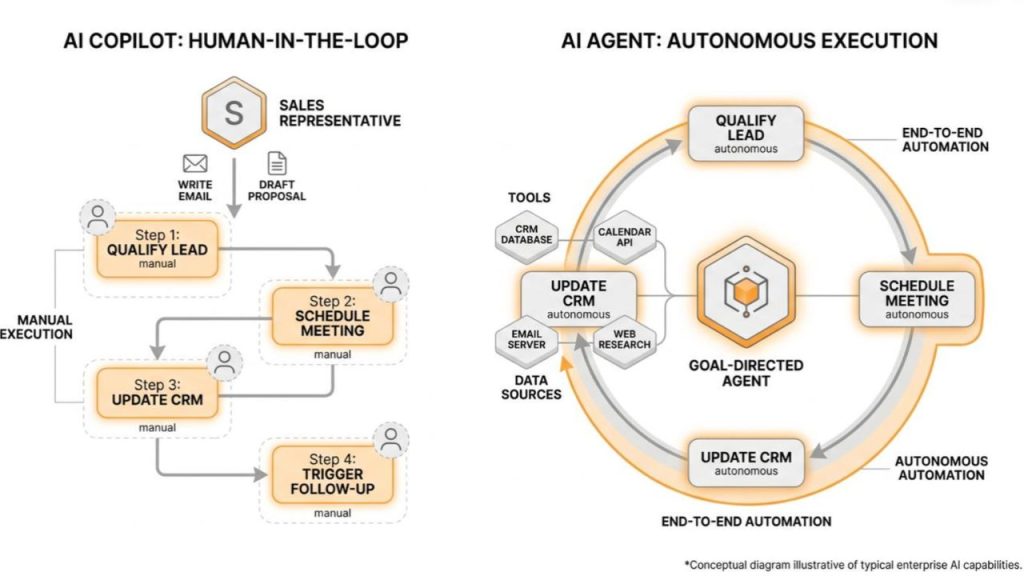
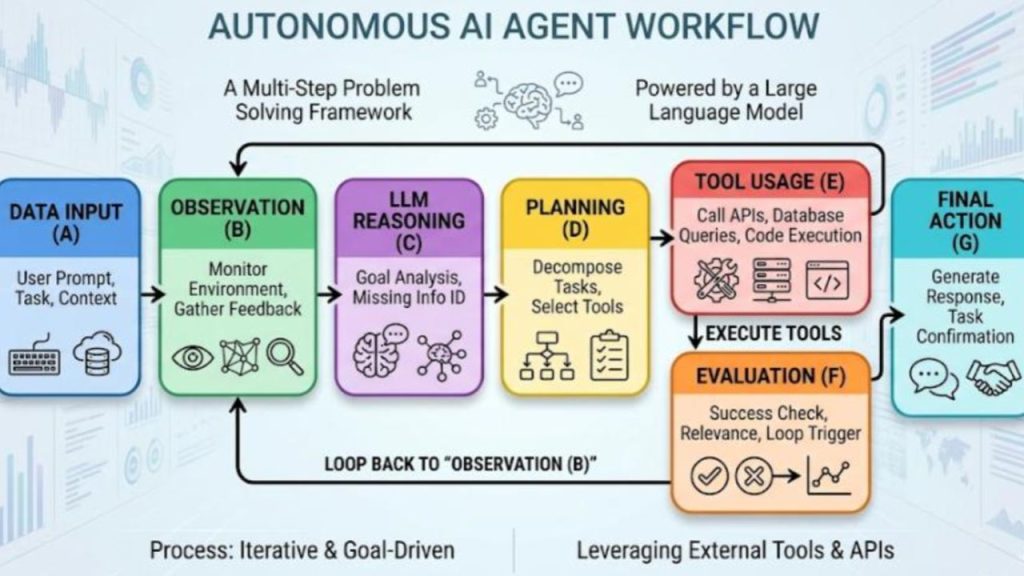
AI agents represent a more advanced approach to automation.
Instead of simply responding to individual prompts, an AI agent can be designed to plan and execute multiple steps toward a defined objective, using approved tools and permissions.
For example, an AI-powered sales agent could:
- Identify potential business leads from approved data sources.
- Organize and categorize those leads.
- Research publicly available company information.
- Prepare personalized outreach drafts.
- Update a connected CRM system.
- Notify the sales team about important opportunities.
Human approval should remain in place for sensitive actions such as sending important communications, making payments, or changing customer records.
According to McKinsey’s November 2025 State of AI survey, 62% of respondents said their organizations were experimenting with AI agents, while 23% reported scaling an agentic AI system in at least one business function. This illustrates the growing interest in moving beyond basic AI assistance. McKinsey & Company
5. How Different Industries Are Using AI in Business Strategy
AI adoption is not limited to technology companies. Different industries are using it to solve specific operational and strategic challenges.



| Industry | Strategic AI applications |
|---|---|
| Healthcare | Medical image analysis, administrative automation, patient support |
| Banking and finance | Fraud detection, risk analysis, financial forecasting |
| Retail and eCommerce | Personalized shopping, inventory forecasting, pricing insights |
| Manufacturing | Predictive maintenance, production optimization, quality control |
| Education | Personalized learning, student support, administrative automation |
| Hospitality and travel | Dynamic pricing, personalized recommendations, booking support |
| Real estate | Property valuation, lead qualification, market analysis |
| Digital marketing | Campaign optimization, audience analysis, content development |
AI in Small and Medium-Sized Businesses
Small and medium-sized businesses can benefit significantly from accessible AI tools.
They do not necessarily need expensive enterprise systems or large technology teams to begin.
A small business can start with:
- AI-assisted customer support.
- Automated appointment scheduling.
- AI-powered accounting assistance.
- Social media content planning.
- Sales reporting and analytics.
- Email marketing automation.
- Inventory management.
The most effective approach is to start with one business challenge, measure the results, and expand gradually.
6. How Businesses Can Develop an Effective AI Strategy
Implementing AI without a clear plan can lead to unnecessary expenses and disappointing results.
A successful AI strategy should connect technology investments with measurable business objectives.
Here is a practical framework businesses can follow.
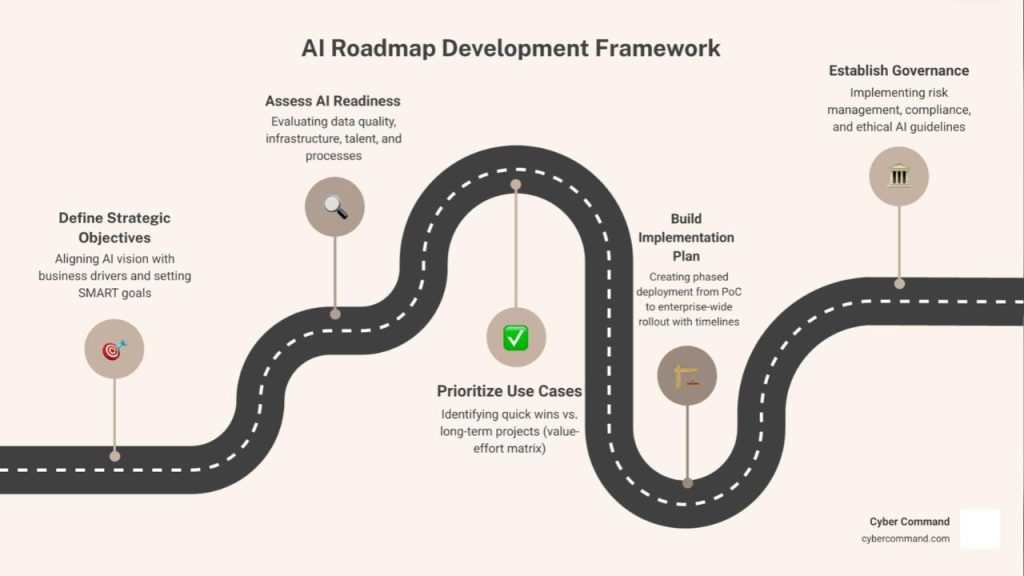
Step 1: Identify Business Challenges
Start by identifying the problems that AI could realistically solve.
Ask questions such as:
- Which business processes consume too much time?
- Where are operational costs increasing?
- Which customer problems occur repeatedly?
- Which decisions require better data?
- Where are employees performing repetitive tasks?
Avoid adopting AI simply because competitors are using it.
Step 2: Define Clear Business Objectives
Set measurable goals before choosing any AI platform.
Examples include:
- Reduce repetitive administrative work by 20%.
- Improve customer response times.
- Increase qualified sales leads.
- Reduce inventory management errors.
- Improve marketing campaign performance.
These are example targets, not guaranteed outcomes.
Step 3: Select the Right AI Tools
Different business problems require different technologies.
For example, a company that needs better customer support may benefit from an AI chatbot, while an organization struggling with financial forecasting may need an analytics platform.
Evaluate tools based on:
- Pricing and operating costs.
- Ease of integration.
- Data security.
- Scalability.
- Accuracy and reliability.
- Customer support.
- Employee usability.
Step 4: Prepare Business Data
AI systems depend on appropriate data to generate useful results.
Businesses should review their data quality, remove unnecessary duplication, establish access controls, and ensure that information is collected and processed lawfully.
Poor-quality data can lead to inaccurate predictions and misleading recommendations.
Step 5: Train Employees and Build AI Skills
AI implementation is not only a technology project. It is also an organizational change.
Employees need to understand how AI tools work, where they are useful, and when human judgment is necessary.
Training should include:
- AI tool usage.
- Prompt writing.
- Data privacy awareness.
- AI-generated content verification.
- Workflow automation.
- Responsible AI practices.
Step 6: Start With Pilot Projects
Instead of introducing AI across the entire organization immediately, begin with a limited project.
For example, a company could introduce an AI customer support assistant for frequently asked questions.
Measure its performance over a defined period before expanding the system.
Step 7: Measure Results and Improve
Monitor whether AI is producing actual business value.
Useful performance indicators include:
- Time saved.
- Cost per task.
- Customer satisfaction.
- Conversion rates.
- Employee productivity.
- Revenue contribution.
- Error rates.
An AI strategy should evolve as the business learns what works and what does not.
7. Best AI Tools Businesses Should Consider in 2026
Businesses have access to an expanding range of AI platforms that support different strategic objectives.



| AI platform | Business application |
|---|---|
| ChatGPT | Research, writing, data analysis, planning |
| Microsoft Copilot | Workplace productivity and document assistance |
| Google Gemini | Research and productivity |
| Salesforce Einstein | CRM intelligence and sales support |
| HubSpot AI | Marketing, customer relationship management |
| Zapier | Connecting applications and automating workflows |
| Power BI | Business intelligence and reporting |
| Notion AI | Documentation and knowledge management |
The best solution depends on the organization’s size, industry, budget, technical requirements, and existing software ecosystem.
Small businesses should prioritize affordability and simplicity, while larger organizations may require advanced security, integration, governance, and scalability.
8. Challenges and Risks of Using AI in Business Strategy
Although AI offers significant opportunities, businesses should understand the risks before introducing it into important operations.
Data Privacy and Security
AI platforms may process sensitive customer, financial, or company information.
Businesses should establish clear policies about what information employees can share with external AI tools.
Inaccurate AI-Generated Information
AI systems can generate incorrect or misleading responses.
Important business reports, financial calculations, legal documents, and customer communications should be reviewed before use.
Implementation Costs
AI implementation may involve software subscriptions, computing resources, integration, employee training, and ongoing maintenance.
Organizations should calculate the total cost of ownership instead of evaluating only the initial subscription price.
Employee Resistance
Some employees may worry about job security or changes to their responsibilities.
Businesses should communicate how AI will support employees, provide training, and involve teams in the implementation process.
Legal and Ethical Responsibilities
Businesses must consider data protection, copyright, transparency, discrimination, and applicable AI regulations.
A responsible AI strategy should establish clear accountability, human oversight, and appropriate risk management procedures.
9. The Future of AI in Business Strategy
The future of business will increasingly involve collaboration between human expertise and intelligent technology.
Several developments are likely to influence business strategy in the coming years.
Autonomous Business Workflows
AI agents will increasingly support connected workflows across sales, operations, marketing, and customer service.
Hyper-Personalized Customer Experiences
Businesses will use AI to deliver more relevant recommendations, services, and communication based on customer needs and preferences.
Predictive Business Management
Organizations will increasingly use AI to anticipate demand, identify risks, forecast performance, and prepare for market changes.
AI-Driven Product Innovation
AI will support product research, design, prototyping, software development, and testing.
Human-AI Collaboration
Rather than replacing every human responsibility, AI will increasingly support employees by handling routine activities and providing information for better decisions.
The organizations most likely to benefit will be those that combine AI capabilities with human creativity, leadership, industry knowledge, and responsible decision-making.
Recent research reinforces this direction. McKinsey’s August 2026 State of AI survey found that 44% of respondents reported scaling AI across their organizations, compared with 38% the previous year. However, achieving measurable financial returns remains a challenge for many businesses. McKinsey & Company+1
10. Practical AI Business Strategy for Startups and Small Businesses
For startups and small businesses, adopting AI does not have to involve significant investment.
A practical strategy is to identify business activities that consume time and resources, then introduce affordable AI solutions to improve efficiency.
Here is an example of a 90-day AI adoption roadmap.
| Period | Business activity | Expected outcome |
|---|---|---|
| Days 1–15 | Identify repetitive tasks and business challenges | AI implementation priorities |
| Days 16–30 | Select AI tools and prepare business data | Initial AI setup |
| Days 31–45 | Introduce AI for marketing and customer support | Improved productivity |
| Days 46–60 | Automate selected administrative workflows | Reduced manual work |
| Days 61–75 | Introduce analytics and reporting | Better business insights |
| Days 76–90 | Evaluate performance and optimize | Scalable AI strategy |
Example: An AI Strategy for a Digital Marketing Agency
Consider a digital marketing agency managing multiple clients.
It could integrate AI into different departments:
- Marketing department: Generate content ideas, research keywords, and develop campaign strategies.
- Graphic design department: Develop creative concepts and accelerate initial design workflows.
- Video production department: Assist with scripts, captions, editing workflows, and content planning.
- Sales department: Research potential clients, organize leads, and prepare sales proposals.
- Management department: Analyze employee performance, project progress, and business reports.
- Customer support: Answer common questions and organize client requests.
This approach allows the agency to improve its workflow without relying entirely on manual processes.
The important principle is to use AI to strengthen the team’s capabilities rather than compromise the quality of its services.
11. How Business Leaders Should Prepare for an AI-Driven Future
Business leaders play an important role in determining whether AI creates meaningful value.
Successful AI adoption requires more than purchasing software. It requires a change in how organizations approach planning, innovation, workforce development, and decision-making.
Leaders should focus on five priorities:
- Develop AI awareness: Understand the capabilities and limitations of modern AI technologies.
- Encourage experimentation: Allow employees to test AI solutions through controlled projects.
- Invest in employee development: Build digital skills and encourage continuous learning.
- Establish AI governance: Create policies for data security, accountability, and responsible usage.
- Connect AI with business growth: Prioritize measurable improvements in revenue, customer experience, productivity, and innovation.
A strong AI strategy begins with leadership but succeeds through organization-wide participation.
Conclusion: AI Is Becoming a Foundation of Modern Business Strategy
Artificial intelligence is changing how businesses plan, operate, compete, and grow. From predictive analytics and intelligent automation to generative AI and autonomous agents, organizations have more opportunities than ever to improve their performance.
However, adopting AI does not automatically guarantee business success.
The real advantage comes from understanding business challenges, selecting appropriate technologies, preparing employees, protecting company data, and measuring results.
For startups, AI can help achieve more with limited resources. For established companies, it can create opportunities to redesign operations, improve customer experiences, and develop new revenue streams.
As technology continues to evolve, businesses that combine human expertise with intelligent automation will be better positioned to adapt to changing markets.
The future of business is not simply about using more AI. It is about using AI strategically to make better decisions, create greater value, and build sustainable competitive advantages.
Frequently Asked Questions (FAQs)
1. What is AI in business strategy?
AI in business strategy is the integration of artificial intelligence into business planning, operations, marketing, financial management, and decision-making to improve efficiency, innovation, and competitiveness.
2. How can AI help businesses grow?
AI can help businesses grow by identifying market opportunities, improving customer experiences, automating repetitive work, optimizing marketing campaigns, and supporting better financial and operational decisions.
3. Is AI useful for small businesses?
Yes. Small businesses can use affordable AI tools for content creation, customer support, sales management, accounting assistance, workflow automation, and business analytics without building their own AI systems.
4. What are the best AI tools for business strategy?
Popular tools include ChatGPT, Microsoft Copilot, Google Gemini, Salesforce Einstein, HubSpot AI, Zapier, and Power BI. The right choice depends on business requirements and budget.
5. Can AI replace human decision-making in business?
AI can support decision-making by analyzing information and identifying patterns. However, human judgment remains essential for strategic planning, leadership, ethical decisions, and situations involving complex business risks.
6. What are the biggest challenges of implementing AI?
The main challenges include data privacy, cybersecurity, implementation costs, inaccurate AI outputs, employee training, integration difficulties, and regulatory compliance.
7. How should a company start implementing AI?
A company should begin by identifying repetitive tasks or business challenges, selecting suitable AI tools, running a small pilot project, training employees, and measuring performance before expanding adoption.
What do you feel about this post?

Like

Love

Happy

Haha

Sad
