

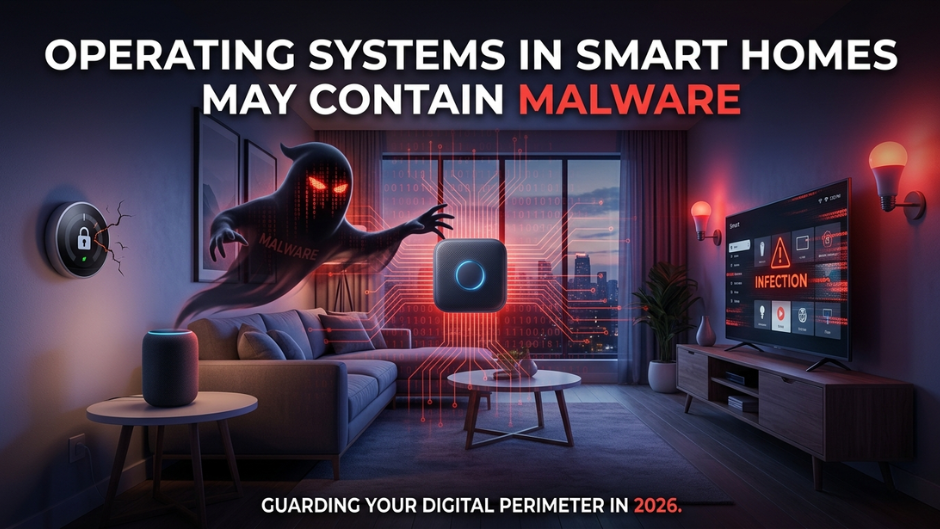
In 2026, the term “home invasion” has taken on a digital meaning. As smart home ecosystems evolve from simple connected bulbs to fully integrated Ambient Intelligence, the underlying Operating Systems (OS) that manage our lives have become prime targets for sophisticated malware.
According to recent 2025–2026 threat reports, the average connected household now faces nearly 30 cyber attacks every 24 hours. Here is a professional look at why your smart home OS might be at risk and how to fortify your digital perimeter.
1. The Vulnerability Gap: Firmware vs. Software

While we are used to regular updates on our phones, many smart home devices—especially budget-friendly streaming sticks, smart TVs, and IP cameras—run on stripped-down versions of Linux or Android that rarely receive security patches.
- The “BadBOX” Effect: A major trend in 2026 is the discovery of “pre-infected” firmware. Malware is often baked into off-brand devices at the factory level, turning your smart plug or TV into a “zombie” node for a botnet the moment it connects to your Wi-Fi.
- Legacy Systems: Many hubs use outdated kernels that contain “Known Exploited Vulnerabilities” (KEV). Hackers use automated AI scanners to find these weak points in seconds.
2. Silent Infections: Residential Proxies and Botnets

The malware in your smart home isn’t always looking to steal your credit card; often, it wants your bandwidth.
- AVrecon & SocksEscort: Recent FBI warnings in 2026 highlighted malware like AVrecon, which infects home routers and IoT devices to sell their IP addresses as “residential proxies.”
- The Consequence: Your home network could be used to facilitate ad fraud, password spraying, or even DDoS attacks on financial institutions, all while you’re simply trying to dim the lights.
3. Emerging Threats: Deepfake Voice Injection

In a voice-activated world, the OS is the gatekeeper. 2026 has seen the rise of AI-driven social engineering.
- The Scenario: Malware intercepting your smart speaker’s OS can “inject” a cloned voice—sounding exactly like a family member—to verbally authorize the unlocking of a smart lock or the disabling of a security perimeter.
Comparison: Smart Home OS Attack Vectors
| Attack Type | Target | Primary Goal |
| Infostealers | Smart Hubs / TVs | Harvesting credentials and session tokens. |
| Botnet Recruitment | Routers / Smart Plugs | Using your IP for global cybercrime (DDoS). |
| Double Extortion | Personal Servers / NAS | Encrypting local data and threatening to leak it. |
| Voice Injection | Smart Speakers | Bypassing physical security via AI-cloned voices. |
4. How to Secure Your Smart Sanctuary
As a professional content creator and tech advocate, I recommend a “Zero Trust” approach to your home network.
- Network Segmentation is Mandatory: Never put your smart toaster on the same network as your banking laptop. Use a Guest Network or a VLAN to isolate IoT devices.
- Disable UPnP and WPS: These “convenience” protocols are open doors for malware. Turn them off in your router settings immediately.
- Hardware Kill-Switches: In 2026, the most secure camera is the one with a physical sliding cover. Use hardware-level privacy whenever possible.
- Audit Your Firmware: Set a quarterly reminder to check for updates. If a manufacturer hasn’t released a patch in over a year, that device is a liability and should be replaced.
Professional Insight: “The most dangerous part of a smart home isn’t the technology—it’s the assumption that it’s secure by default.”