

Gaming in 2026, the “Console vs. PC” debate is no longer just about which box has better graphics. With the rise of the PS5 Pro, the Nintendo Switch 2, and the RTX 50-series GPUs, the gap between these two worlds is shifting in ways we didn’t expect a few years ago.
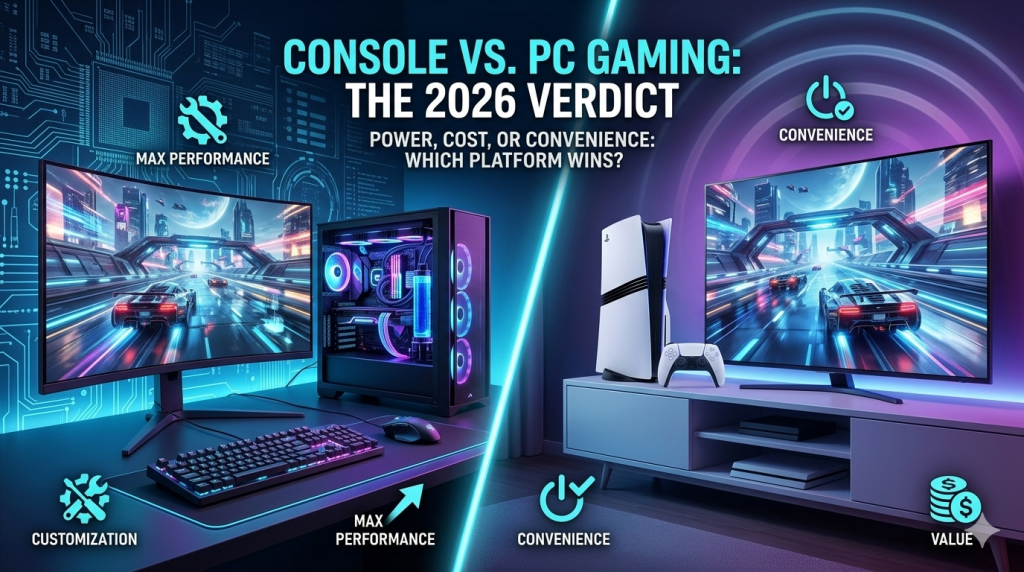
If you’re standing in the electronics aisle (or staring at an open browser tab) wondering where to drop your hard-earned cash, this guide breaks down the data-driven differences between console and PC gaming in 2026.
1. Performance: Raw Power vs. Reliable Optimization
In terms of raw numbers, PC is still king. A high-end 2026 rig equipped with an RTX 5090 can push 8K resolution at 240Hz using DLSS 4.0. Consoles, while powerful, generally target 4K at 60 or 120 FPS using dynamic resolution scaling.
- The PC Edge: You get unmatched fidelity, ultra-wide monitor support, and the ability to mod games (like adding 10,000+ custom items to Skyrim or GTA VI).
- The Console Edge: Consistency. Because developers know exactly what hardware is inside a PS5 Pro or Xbox, the games are optimized perfectly for that specific “box.” You’ll rarely deal with the shader compilation stutters or driver crashes that occasionally plague PC launches.
2. The Cost Evolution: Upfront vs. Long-term
The “PC is more expensive” argument is half-true. In 2026, mid-range GPU prices have stabilized, but building a solid PC still requires a larger initial investment.
| Feature | Console (e.g., PS5 Pro) | Gaming PC (Mid-Range) |
| Upfront Cost | ~$700 – $800 | ~$1,200 – $1,600 |
| Online Play | Paid Subscription (~$80/year) | Free |
| Game Prices | Standard ($70+) | Frequent Sales (Steam/Epic) |
| Multitasking | Only Gaming/Media | Gaming + Work + Creative |
Pro Tip: While a console is cheaper on Day 1, a PC often becomes cheaper by Year 4 because you aren’t paying for “Xbox Game Pass Core” or “PS Plus” just to play online, and Steam sales are historically more aggressive than console storefronts.
3. Library & Exclusives: The Walls are Falling
For decades, you bought a console for its exclusives. In 2026, that “walled garden” is crumbling.
- Sony & Microsoft: Most PlayStation hits now arrive on PC (though often 6–12 months later). Xbox titles launch on PC Day One.
- Nintendo: The Switch 2 remains the only place to officially play Mario and Zelda, making it the strongest “second platform” for most gamers.
- PC Exclusives: PC remains the home of the massive Indie scene, complex Strategy games (Civilization, Total War), and the highest-tier competitive Esports titles.
4. Convenience vs. Customization
This is the “Vibe Check” of the debate.
- Consoles are “Lean Back”: You sit on the couch, press one button on a controller, and you’re in. It’s a frictionless, social experience designed for the living room.
- PCs are “Lean Forward”: You have total control. You can change your thermal paste, overclock your RAM, and use any peripheral—from a flight simulator yoke to a specialized MMO mouse.
The 2026 Verdict: Which is for You?
Choose a Console if:
- You want plug-and-play simplicity.
- You prefer gaming on a large 4K TV from the couch.
- You have a fixed budget and don’t want to worry about “system requirements.”
Choose a PC if:
- You want the absolute best visual experience possible.
- You play competitive shooters or strategy games.
- You want a machine that doubles as a productivity powerhouse for work or content creation.
The Hybrid Trend: Interestingly, the most popular choice in 2026 is the Handheld PC (like the Steam Deck 2 or ASUS ROG Ally). These devices offer PC power with console-like portability, effectively ending the war for many gamers.