

Artificial intelligence AI improve cybersecurity
The digital landscape of 2026 is no longer a place of “if” you get attacked, but “when.” As cybercriminals weaponize AI to launch hyper-personalized phishing and automated intrusions, the traditional, human-led defense model has reached its breaking point.
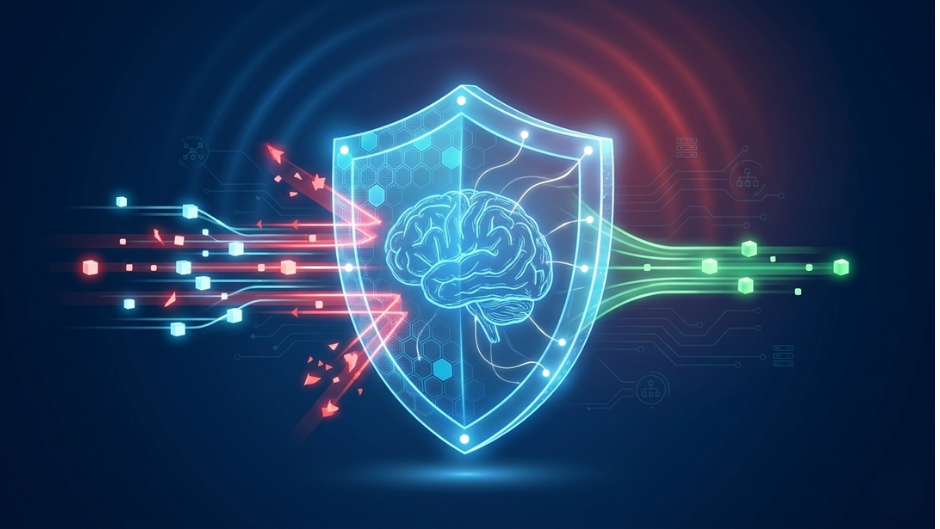
The good news? The same technology being used to attack us is becoming our most powerful shield. In 2026, AI isn’t just a “feature” in cybersecurity—it is the backbone of a modern, autonomous defense ecosystem.
1. Operating at “Machine Speed”
The most significant advantage AI brings to the table is speed. In 2025, we saw the speed of data exfiltration by hackers quadruple. Human analysts, no matter how skilled, simply cannot keep up with thousands of alerts per second.
- Autonomous Response: Modern AI systems can detect, investigate, and contain a threat in milliseconds. While a human might take hours to verify a breach, an AI can isolate a compromised server or block a malicious IP address instantly.
- Hyper-Automation: AI handles the “boring” work—log analysis, vulnerability scanning, and routine patch management—allowing human experts to focus on high-level strategy and complex “red teaming.”
2. Moving from Reactive to Predictive
For decades, cybersecurity was reactive: something broke, and we fixed it. AI has flipped the script by introducing Predictive Threat Modeling.
By analyzing global telemetry and exploit trends, AI can predict which vulnerabilities are most likely to be weaponized next. This allows security teams to deploy “protective patches” proactively—fixing the hole before the hacker even finds it.
The 2026 Inflection Point: Leading organizations are now moving toward “Self-Healing Networks” that automatically correct misconfigurations and “drift” in cloud accounts without human intervention.
3. The End of “Guesswork” in Identity
Identity is the new perimeter. In 2026, roughly 90% of breaches involve stolen credentials or tokens. Static passwords are a relic of the past; AI has replaced them with Behavioral Biometrics.
AI monitors “User and Entity Behavior Analytics” (UEBA) to create a digital fingerprint of what “normal” looks like for you:
- How fast do you type?
- What time of day do you usually access specific files?
- Which geographical locations do you typically log in from?
If a hacker logs in with your correct password but moves through the system in a way that doesn’t match your “fingerprint,” the AI triggers a “Zero-Trust” challenge immediately.
4. Fighting Fire with Fire: Gen-AI vs. Gen-AI
Generative AI (Gen-AI) has made phishing attacks nearly perfect. No more “bad grammar” or “suspicious links”—AI can now craft a hyper-personalized email that looks exactly like it came from your CEO.
To counter this, defenders use Defensive Gen-AI to:
- Reverse-Engineer Malware: AI can deconstruct new, never-before-seen malware in seconds to understand its intent.
- Simulate Attacks: Using “Red Agents” (autonomous AI hackers), companies stress-test their own systems 24/7 to find weaknesses.
- Draft Incident Reports: AI can summarize a complex multi-stage attack into a plain-English report for executives in real-time.
The Human-Centric Future
Despite the rise of autonomous systems, the “human in the loop” remains critical. AI is a force multiplier, not a replacement. In 2026, the best cybersecurity posture is a Hybrid Model: AI manages the scale and speed, while humans provide the context, ethics, and strategic judgment.
The Bottom Line: In an era where attackers move at the speed of light, staying secure requires a system that learns as fast as it defends.