
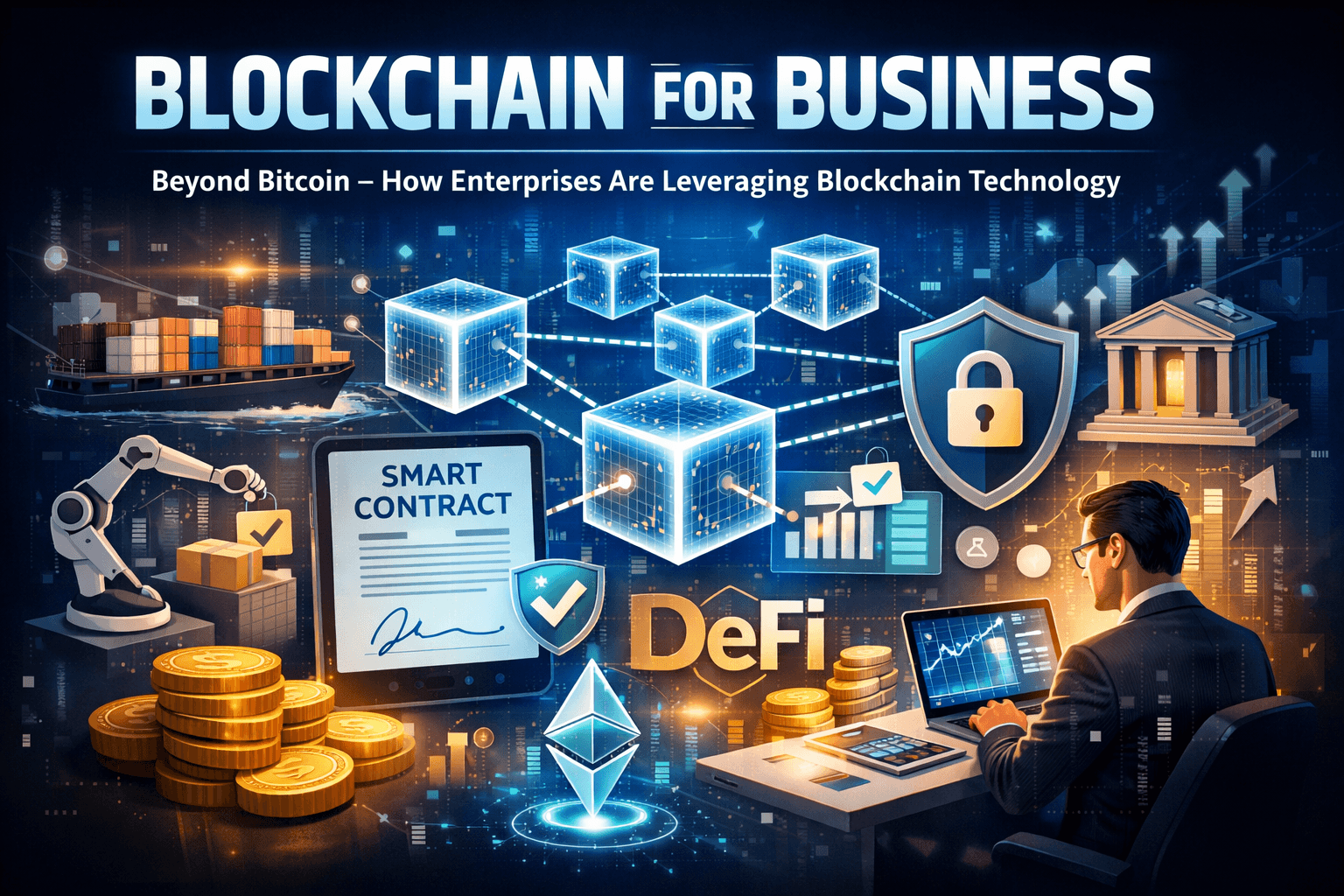
Blockchain for Business: Beyond Bitcoin – How Enterprises Are Leveraging Blockchain Technology
Introduction
When most people hear blockchain, they think of Bitcoin. But blockchain technology has far more potential than cryptocurrencies alone. Modern businesses are now harnessing blockchain to improve security, transparency, efficiency, and trust across industries like finance, supply chain, healthcare, digital advertising, and more.
For enterprises, blockchain isn’t just a tech trend—it’s a strategic business asset that can reduce costs, prevent fraud, automate operations, and build stronger relationships with partners and customers.
In this article, we’ll explore how blockchain for businesses worldwide, why companies should look beyond Bitcoin, and how small to large enterprises can adopt it effectively.
What is Blockchain?
At its core, blockchain is a decentralized digital ledger. It stores data in “blocks” that are linked chronologically, forming a secure chain. Once added, this data cannot be altered without network consensus, making it tamper-proof.
Key Features of Blockchain for Business:
- Decentralization: No single authority controls the data
- Transparency: All authorized participants can view transactions
- Immutability: Data cannot be altered or deleted
- Security: Advanced cryptography protects records
- Trustless System: Reduces reliance on intermediaries
These features make blockchain ideal for businesses where accuracy, accountability, and security are essential.
Why Businesses Are Adopting Blockchain
Traditional business systems often rely on intermediaries, manual processes, and centralized databases. Blockchain addresses these inefficiencies while creating new opportunities for innovation and automation.
Benefits for Businesses
- Enhanced Transparency and Trust
Blockchain provides a single source of truth for all stakeholders. This builds trust between partners, suppliers, and customers without relying on third-party verification. - Improved Security
Data stored on blockchain is encrypted and distributed, making it highly resistant to hacking and fraud. - Cost Reduction
By removing intermediaries like brokers, banks, and auditors, blockchain can significantly reduce transaction and operational costs. - Faster Transactions
Blockchain enables near real-time settlement, reducing delays caused by traditional banking and administrative processes. - Automation Through Smart Contracts
Smart contracts are self-executing agreements triggered by predefined conditions. They minimize manual work, reduce errors, and ensure contractual obligations are automatically met.
Blockchain Use Cases in Modern Business
Blockchain technology is transforming the way modern businesses operate by introducing transparency, security, and efficiency across industries. From finance and supply chain management to healthcare, real estate, and digital marketing, blockchain enables decentralized data sharing, smart contracts, fraud prevention, and real-time tracking of transactions. It explores practical blockchain use cases in modern business, highlighting how organizations leverage distributed ledger technology to reduce costs, improve trust, enhance operational efficiency, and create innovative business models. Ideal for entrepreneurs, startups, and enterprises, this article explains real-world applications, benefits, challenges, and future trends of blockchain adoption in today’s competitive digital economy.
1. Supply Chain Management
Blockchain technology can track products from origin to delivery, making every step transparent and verifiable.
Benefits:
- Prevents counterfeit goods
- Improves inventory management
- Enhances supplier accountability
- Builds consumer trust
Industries such as food, pharmaceuticals, manufacturing, and luxury goods are leading adoption.
2. Financial Services
Banks and fintech companies are using blockchain for:
- Cross-border payments
- Trade finance
- Fraud detection
- Digital identity verification
Blockchain technology reduces transaction time from days to minutes while lowering fees and ensuring compliance.
3. Smart Contracts for Automation
Smart contracts can automate tasks like:
- Supplier payments
- Insurance claims
- Employee payroll
- Advertising campaign payments
This improves efficiency and reduces disputes while keeping processes transparent and reliable.
4. Healthcare
Healthcare organizations leverage blockchain for:
- Secure patient records
- Accurate medical history tracking
- Transparent insurance claims
- Data sharing among authorized entities
Blockchain technology ensures data privacy, security, and compliance while reducing administrative costs.
5. Digital Identity & KYC
Blockchain-based digital identities give users control over their personal data and help companies comply with KYC and AML regulations.
Advantages:
- Stronger data privacy
- Reduced compliance risk
- Streamlined onboarding processes
6. Advertising & Marketing
Blockchain technnology is transforming digital advertising by addressing challenges like ad fraud, fake traffic, and lack of transparency.
Business Benefits:
- Verified impressions and clicks
- Transparent advertiser–publisher relationships
- Fair payment systems
- Reduced fraud and bot traffic
This is particularly valuable for programmatic ad platforms, publishers, and global advertisers.
7. Real Estate and Asset Tokenization
Blockchain technology allows tokenization of real-world assets:
- Real estate
- Artwork
- Company shares
This enables fractional ownership, faster transactions, and global investment opportunities.
Public vs Private Blockchain
Public Blockchain
Public blockchains are transforming modern businesses by enabling open, transparent, and decentralized digital ecosystems. Unlike traditional systems, public blockchains allow anyone to participate, verify transactions, and access data without central authority. Businesses use public blockchain networks for global payments, decentralized finance (DeFi), cryptocurrencies, NFTs, tokenized assets, crowdfunding, and transparent auditing. It explores how public blockchain empowers innovation, builds trust, reduces dependency on intermediaries, and creates new revenue models for startups and enterprises operating in the global digital economy.
- Open and decentralized
- High transparency
- Example: Ethereum
Private Blockchain
Private blockchains are designed for enterprises that require high levels of control, privacy, and scalability. Operated within permissioned environments, private blockchain networks help businesses securely manage internal operations such as supply chain tracking, identity verification, document management, data sharing, and regulatory compliance. It explains how private blockchain solutions improve operational efficiency, reduce fraud, ensure data integrity, and support collaboration between trusted partners while maintaining confidentiality and governance.
- Controlled access
- Faster performance
- Example: Hyperledger Fabric
Most businesses adopt private or hybrid blockchains technology for better control, privacy, and regulatory compliance.
Blockchain for SMEs and Startups
Blockchain technology enables SMEs and startups to improve transparency, reduce operational costs, and build trust without heavy infrastructure investments. It explores how small and growing businesses can use blockchain for secure payments, smart contracts, supply chain tracking, data protection, and digital identity, helping them scale efficiently and compete in the modern digital economy. Blockchain isn’t just for large enterprises. SMEs and startups can leverage it to:
- Reduce global trade barriers
- Secure payments
- Automate contracts
- Build trust with customers
Startups can also explore token-based incentives and decentralized platforms to create innovative business models.
Blockchain and Regulatory Compliance
Businesses often worry about regulations. Blockchain can strengthen compliance by providing immutable audit trails and automated reporting via smart contracts. Blockchain helps businesses achieve regulatory compliance by providing transparent, immutable, and auditable records. It explores how organizations leverage blockchain for secure data management, financial reporting, KYC/AML processes, and adherence to industry regulations, reducing risk and enhancing trust with regulators and stakeholders.
Industries that benefit:
- Finance
- Insurance
- Healthcare
- Digital advertising
Blockchain Integration With Existing Systems
Integrating blockchain with existing business systems helps organizations enhance security, transparency, and efficiency without overhauling their infrastructure. It explores practical strategies for connecting blockchain with ERP, CRM, supply chain, and payment systems, enabling seamless workflows, real-time data verification, and smarter decision-making. Blockchain doesn’t always replace existing software. Many companies adopt a hybrid approach, integrating blockchain with:
- ERP systems
- CRM platforms
- Cloud services
- Advertising analytics platforms
This ensures gradual adoption without disrupting operations.
Blockchain, Data Ownership, and Privacy
Blockchain technology fundamentally changes how data is controlled, shared, and secured in modern business ecosystems. Unlike traditional centralized systems, blockchain empowers users and organizations with greater ownership and privacy over their data. Blockchain technology empowers businesses and users to own and control their data.
- Decentralized Data Control: In a blockchain network, data is distributed across multiple nodes rather than stored in a single central server. This decentralization ensures that no single entity has unilateral control over the data, giving users more ownership and reducing the risk of misuse.
- Immutable and Transparent Records: Blockchain’s immutable ledger records all transactions permanently. This transparency allows users to verify the integrity of data while maintaining a secure audit trail for compliance and accountability.
- Privacy Through Encryption: Sensitive information on blockchain can be encrypted and accessed only by authorized parties using cryptographic keys. This ensures that personal and business data remains private while still enabling secure verification and sharing.
- Enhanced Compliance: By combining privacy-focused design with transparent auditing, blockchain helps businesses comply with data protection regulations such as GDPR, CCPA, and industry-specific privacy laws.
- User Empowerment: Blockchain gives individuals and organizations control over who can access their data and under what conditions, enabling selective disclosure and reducing dependency on third-party intermediaries.
Blockchain technology strengthens data ownership and privacy by giving users control, protecting sensitive information, and maintaining transparent, verifiable records—making it a powerful tool for businesses and consumers alike.
Advantages:
- Ethical data usage
- Reduced legal risk
- Transparent agreements
- Better consumer trust
This is increasingly important for Web3 platforms, marketplaces, and ad networks (adsaro).
Web3 and Blockchain
Blockchain is the foundation of Web3, the decentralized internet. Web3 represents the next generation of the internet, where users regain control over their data, identities, and digital assets. At the core of Web3 is blockchain technology, which provides the decentralized infrastructure that enables trustless interactions without relying on central authorities.
- Decentralization: Unlike Web 2.0, where platforms like Google, Facebook, or Amazon control user data, Web3 is built on decentralized networks powered by blockchain. This means users own their data and can interact directly with applications and other users.
- Blockchain as the Foundation: Blockchain ensures that Web3 platforms are secure, transparent, and immutable. It allows for the creation of decentralized applications (dApps), cryptocurrencies, NFTs, and smart contracts that operate autonomously and transparently.
- Smart Contracts and Automation: Web3 leverages blockchain-based smart contracts, which automatically execute agreements or transactions when predefined conditions are met. This reduces intermediaries, enhances efficiency, and ensures trust.
- Digital Ownership and Identity: Web3 gives users control over their digital identities and assets. Through blockchain, individuals can securely own and manage NFTs, crypto tokens, and personal data across multiple platforms.
- New Business Models: Web3 enables decentralized finance (DeFi), peer-to-peer marketplaces, decentralized social networks, and token-based economies, allowing startups and enterprises to innovate beyond traditional business models.
Web3 is the evolution of the internet powered by blockchain, giving users greater control, security, and ownership, while opening opportunities for decentralized business models, transparency, and trustless interactions.
Opportunities for Businesses:
- Decentralized apps (dApps)
- Token-based loyalty systems
- DAO-driven governance models
- Creator monetization ecosystems
Early adoption provides a competitive advantage in emerging digital economies.
Blockchain and Sustainability
Blockchain helps businesses track carbon credits, ESG compliance, and ethical sourcing, while reducing paperwork and manual processes. Blockchain technology is increasingly being used to promote sustainable business practices and environmental responsibility. By providing transparent, immutable, and traceable records, blockchain helps organizations reduce waste, improve resource efficiency, and demonstrate accountability in their sustainability efforts.
- Transparent Supply Chains: Blockchain allows companies to track products from origin to consumer, ensuring ethical sourcing, reducing fraud, and verifying environmental claims. This is particularly useful in industries like food, fashion, and minerals.
- Energy Efficiency and Green Initiatives: Blockchain can optimize energy grids, monitor carbon credits, and support renewable energy trading by providing a secure, auditable record of energy generation, consumption, and emissions.
- Circular Economy Support: Blockchain helps businesses implement circular economy models by tracking product life cycles, recycling processes, and reuse initiatives, ensuring resources are used efficiently and responsibly.
- Carbon Credit and Environmental Markets: Blockchain enables transparent tracking and trading of carbon credits, helping organizations offset emissions and incentivize sustainability while reducing the risk of double-counting or fraud.
- Accountability and Reporting: With immutable records, companies can provide verifiable proof of their sustainability initiatives to regulators, investors, and consumers, enhancing credibility and trust.
Blockchain empowers businesses to adopt sustainable practices by improving transparency, traceability, and accountability, supporting environmental responsibility while fostering trust with stakeholders.
Industries that benefit:
- Manufacturing
- Logistics
- Consumer goods
- Global brands
How Businesses Can Start With Blockchain
Businesses can start with blockchain by identifying real operational problems, choosing the right blockchain model (public or private), and implementing secure, scalable solutions such as smart contracts and decentralized ledgers. This topic explains practical steps for adopting blockchain technology, including use case selection, platform choice, pilot implementation, and compliance considerations, helping organizations innovate efficiently while minimizing risk.
Step-by-step guide:
- Identify a real business problem
- Choose public, private, or hybrid blockchain
- Start with a pilot project
- Measure ROI and efficiency
- Scale gradually
Consulting blockchain experts can reduce risk and accelerate adoption.
Common Blockchain Myths
Myth 1: Blockchain is only for cryptocurrency
- Reality: Businesses use it for smart contracts, data security, and automation.
Myth 2: Blockchain is expensive
- Reality: Cloud-based and private blockchains make adoption affordable.
Myth 3: Blockchain isn’t secure
- Reality: Properly implemented blockchain is more secure than traditional databases.
Blockchain as a Competitive Advantage
Blockchain technology can provide businesses with a significant competitive edge by enabling transparency, security, and efficiency that traditional systems often lack. By leveraging blockchain, companies can:
- Increase Trust and Transparency: Blockchain’s immutable ledger ensures that all transactions and records are verifiable and tamper-proof. This builds stronger trust with customers, partners, and regulators.
- Streamline Operations: Smart contracts automate repetitive processes, reducing administrative overhead and errors. For example, supply chain transactions, payments, and compliance tasks can be executed automatically, saving time and costs.
- Enhance Security: Decentralized data storage makes it extremely difficult for hackers to compromise information. This is especially critical for industries handling sensitive data, like finance, healthcare, and logistics.
- Enable Innovative Business Models: Blockchain allows new models such as tokenization, decentralized finance (DeFi), loyalty programs, and digital marketplaces, giving early adopters a market advantage.
- Foster Customer Loyalty: By offering transparent and secure services, businesses can improve brand reputation and differentiate themselves from competitors still using legacy systems.
Companies that strategically adopt blockchain can operate more efficiently, reduce costs, innovate faster, and build stronger trust, giving them a tangible competitive advantage in today’s digital economy.
Adopting blockchain provides:
- Stronger trust signals
- Faster operations
- Better data integrity
- Global scalability
Companies that look beyond Bitcoin and adopt real-world blockchain solutions gain long-term growth and innovation advantages.
Conclusion
Blockchain for Business: Beyond Bitcoin
Blockchain is more than a cryptocurrency technology—it’s a strategic tool for modern businesses. From SMEs to large corporations, blockchain can:
- Reduce costs
- Improve transparency
- Automate operations
- Strengthen compliance
Enterprises that embrace blockchain now are positioning themselves for future-ready growth, digital trust, and competitive advantage.
Blockchain for Business: Beyond Bitcoin
FAQs
1. Is blockchain useful for businesses?
Yes. It improves transparency, security, automation, and efficiency across industries.
2. Can small businesses use blockchain?
Absolutely. SMEs can use blockchain for secure payments, automated contracts, and global operations.
3. Is blockchain only for cryptocurrency?
No. Most business applications don’t involve crypto at all.
4. How secure is blockchain for enterprise use?
Blockchain is highly secure due to its decentralized, encrypted, and immutable architecture.